
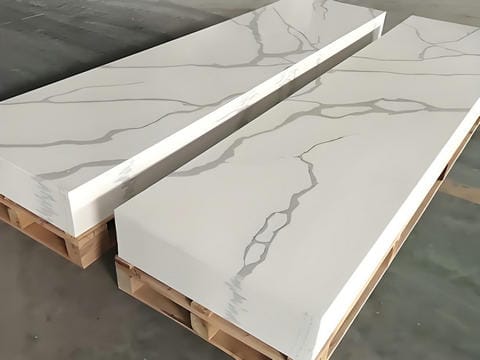
Small quartz slabs
Small quartz slabs have strong global competitiveness due to their cost performance, wide application and stable supply. Specifically, their market features “core region leading, emerging region growing”.
Global demand and production capacity will drive small slabs to expand market share. Furthermore, rising urbanization and old house renovation demand will further release their potential.
Overview: Rising Global Demand for Small Quartz Slabs
Quartz Stone: Mainstream Material in Global Decoration Market
In the current global home decoration and construction market, quartz stone serves as a mainstream material for countertops, feature walls and windowsills, mainly thanks to its wear resistance, stain resistance and environmental protection.
Specifically, 2026 research shows the global quartz stone market hit $20.13 billion in 2025 and will likely reach $22.97 billion in 2026. Notably, small quartz slabs, as a cost-effective segment, enjoy wide global demand.
Core Specifications, Series and Global Market Distribution of Small Quartz Slabs
Small quartz slabs enter the international mid-to-low-end market with flexible adaptability and low transportation loss. Specifically, they have core sizes of 3050×750mm and 2440×750mm, and thicknesses of 12mm, 15mm and 20mm.
Meanwhile, product series include basic home decoration, mid-end minimalist and high-end texture. Additionally, core markets include Asia-Pacific (44%), North America (27%) and Europe (21%), with radiation to emerging regions.
Cost-Effectiveness: Core Competitiveness in the Global Market
With outstanding cost performance, small quartz slabs stand out globally. Specifically, they find wide use in various decorative scenarios, adapt to different regions’ needs and thus become a popular choice for rigid demand decoration.
Widespread Application in Rigid Demand Decoration
Small quartz slabs gain popularity for rigid demand decoration worldwide. For instance, they meet consumers’ quality requirements, help control budgets and also see rising demand in old house renovation and new projects.
Core Competitiveness and Market Growth Contribution
Cost performance forms their core competitiveness. For example, they cost less than large slabs and thus gain increasing penetration in the mid-to-low-end market. Furthermore, in 2026, the global quartz slab market will reach $7.65 billion, with small slabs driving growth.
Mid-Range Practical Products: Mainstream Global Sales
Pricing and Core Specifications of Mid-Range Products
Mid-range small quartz slabs (120-180 USD/m) contain 90% quartz sand, feature diverse colors, core sizes of 3050×750mm and 2440×750mm, and thicknesses of 12mm/15mm.
In particular, they belong to the mid-end minimalist series, account for over 60% of global small slab sales and also cover mainstream consumers in major markets.
This type of small quartz slabs finds wide use in global home decoration and simple projects. Moreover, it balances quality and cost, and adapts to residential needs in Asia-Pacific, North America and Europe.
Specifically, people use 12mm slabs for walls and windowsills, 15mm ones for countertops, and they also prove especially popular in old house renovation projects.
Target Group of Mid-Range Products
These cost-effective slabs suit ordinary families in developed countries and middle-income families in developing countries, mainly in China, India, the US, Canada, Germany and Italy.
In fact, they make up over 75% of mid-range product consumption, as consumers favor them for cost performance and wide application scenarios.
In North America, quartz overtook granite in 2023, accounting for 61% of high-end countertop installations. Consequently, consumers choose small quartz slabs as their first choice for home decoration due to their flexibility.
Transportation Advantages of Mid-Range Products
Small quartz slabs have low transportation costs, which enhances their competitiveness. As a result, this benefits emerging markets like Southeast Asia and Brazil and also accelerates market penetration.
Additionally, this advantage reduces purchasers’ costs and attracts global bulk purchases. For example, Xiamen stone enterprises serve as major global suppliers and export to 118 countries and regions.
Market Performance of Mid-Range Products
Cost-effective small quartz slabs serve as global mainstream products. Specifically, driven by Asia-Pacific’s urbanization, mid-range demand grows at 14.13% annually, far exceeding the global average.
Global Consumption Volume and Growth Trend
Global small quartz slab consumption exceeded 7.4 million square meters in 2023, with mid-range products accounting for over 60%. Notably, demand keeps rising steadily.
High-End Minimalist Products: Meeting the Needs of High Quality with Limited Budget
Pricing and Raw Materials of High-End Products
High-end small quartz slabs (180-270 USD/m) use high-quality raw materials and belong to the high-end texture series. Specifically, they have core sizes of 3050×750mm and 2440×750mm, and thicknesses of 15mm/20mm.
They focus on high-end colors, supply North America and Europe, account for 25% of global small slab sales, and notably, North America takes 45% of high-end sales.
These high-end slabs meet quality-oriented consumers’ needs and find use in global high-end home decoration and small commercial projects. For instance, people use 20mm slabs for commercial countertops and 15mm ones for high-end walls.
Furthermore, high-end residential and commercial spaces in Germany, the UK, the US and Canada show strong demand for them.
Quality and Appearance of High-End Products
High-end products have hardness and stain resistance close to large slabs and support special-shaped processing. Specifically, they have a Mohs hardness of 7, heat resistance over 150℃, and stain resistance over 95%.
In detail, 20mm slabs offer higher hardness and better load-bearing capacity; 15mm ones are lighter and more adaptable, which thus meets mature markets’ quality requirements.
Color Advantages and Adaptability to Decoration Styles
With high-end colors like texture gray, they gain competitiveness in the high-end market. Moreover, they suit European minimalist and North American high-end residential styles and serve as an ideal choice for local highlights.
Target Scenarios of High-End Products
These slabs target global groups that pursue quality but have limited budgets. Specifically, they find use in home and commercial decoration in developed countries, mainly in North American commercial projects and European high-end residences.
Application Ratio in North American Commercial Projects
In North American commercial projects, 73% of builders specify quartz products. For example, they choose small quartz slabs for over 30% of applications due to their flexible adaptability.
Global Market Demand: Aligning with Consumption Trends
Rigid Demand Market Driven by Urbanization
Small quartz slabs rise globally with high cost performance and align with decoration trends. Notably, Asia-Pacific, the largest and fastest-growing market (44% in 2025), sees demand driven by China and India.
Supply Support from Global Manufacturers
Global production capacity supports small quartz slabs to meet rigid demand. For instance, the world’s top six quartz manufacturers account for over 17% of the market and ensure stable supply.
Demand Support from the Decoration Market
The global old house renovation market provides broad space. For example, small slabs have low loss and controllable cost, so people use them widely. Additionally, potential demand exceeds 60 million square meters.
Specifically, North America accounts for over 35% of global quartz kitchen countertop demand, and over 20 million US houses enter the renovation golden period.
Application in Global Cabinet Countertop Renovation
Small slabs avoid cutting waste and reduce costs, so they become the preferred decoration material. For instance, in 2025, global quartz cabinet countertop demand exceeded 100 million square meters, with small slabs taking a large share.
Consumers’ Preference for Small Slabs
Consumers favor small slabs for cost performance and use them for local countertop and windowsill replacement. For example, North American/European consumers value quality; Asia-Pacific/Southeast Asian ones focus on cost performance.
Consequently, these preference differences drive product iteration and upgrading.
Expansion of Application Scenarios in Furniture Manufacturing
Small quartz slabs find wide use in small spaces and local decoration. Additionally, 118 countries apply quartz surfaces in furniture manufacturing, which further expands demand scenarios.
Personalized Demand: Highlighting the Advantages of Small Slabs
Adaptability to Small and Special-Shaped Spaces
Small quartz slabs excel in personalized demand. Specifically, different specs and series adapt to small and special-shaped spaces. For example, the basic home decoration series suits small Southeast Asian/European residences.
Meanwhile, the high-end texture series fits North American/European commercial catering spaces. Furthermore, Indonesia becomes an emerging demand market due to growing catering and mall decoration needs.
Small slabs allow flexible cutting with low loss. Specifically, different specs, thicknesses and series adapt to various spaces and decoration levels, with high cost performance as the core support.
In Indonesia, small slabs are in the initial stage. For example, people focus on the basic series, 12mm thickness and 2440×750mm size, which offers huge growth space.
Diversification of Global Procurement Channels
Diversified global procurement channels promote small slabs’ circulation. For instance, North American/European purchasers buy via large wholesalers; Asia-Pacific/Southeast Asian ones via cross-border e-commerce and local markets.
Additionally, Middle Eastern countries purchase via foreign trade, which ensures high circulation transparency.
Prospect of Global Export Volume
Transparency promotes global circulation, reduces procurement costs and attracts more purchasers. Specifically, we expect 2026 global small quartz slab exports to achieve significant breakthroughs.
Impact of Transparent Pricing on Popularization
International purchasers and consumers can easily compare prices. For example, North American/European prices are higher; Asia-Pacific/Southeast Asian prices are more cost-effective, forming clear stratification.
Long-Term Growth Potential Driven by Market Demand
This promotes small slabs’ global popularization. Consequently, we expect the global quartz stone market to reach $75.45 billion by 2035, with small slabs continuing to drive growth.
Global Market Supply: Stable Supply and Cost Advantages
Global Major Suppliers of Small Slabs
China serves as the world’s main small quartz slab supplier with strong production capacity. For instance, Xiamen stone enterprises are leading suppliers and export to 118 countries and regions.
Additionally, Shuiguo Town, Shandong, has 16 enterprises and 96 production lines. Meanwhile, international brands like Cosentino Group also supply the high-end market.
Supply Capacity and Price Stability
China’s standard plate output accounts for over 36% of the national total. Specifically, enterprises export a large number of small slabs, covering all mainstream specs, thicknesses and series.
Global annual supply exceeds 8 million square meters, which thus ensures price stability and alleviates impacts from raw material price fluctuations.
Impact of Tariff Policies on Global Supply
Tariff policies affect global supply. For example, major import regions (North America, Europe, Southeast Asia) face higher import costs due to tariff increases, which promotes local production.
Cost Control of the Upper Supply Chain
China’s optimized upper supply chain reduces production costs. Meanwhile, global suppliers promote innovation; recycled material slabs cover 12mm/15mm thicknesses and basic/mid-end series, with a 30% market share.
Coping with Market Challenges and Improving Competitiveness
This improves quality and competitiveness while keeping prices affordable. Specifically, it copes with challenges like silica powder compliance costs (35% market impact) and raw material fluctuations.
Competitive Advantages: Comparison with Other Stones
Advantages Compared with Natural Stone
Small quartz slabs have dual advantages: cost performance and wide application. For example, over 72% of global buyers prefer quartz over granite for its durability, color consistency and higher stain resistance (58% higher).
They cost over 50% less than natural marble, have no radiation and are easy to clean. Additionally, they have a 60% longer service life and 50% lower maintenance cost, which enhances competitiveness.
Advantages Compared with Ordinary Artificial Stone
Small quartz slabs cost slightly more than ordinary artificial stone but have better performance. Specifically, they have scratch resistance exceeding 80%, water absorption below 0.02%, and suit high-frequency use.
Application Ratio in Modern Kitchen Renovation
Over 52% of global modern kitchen renovation projects use artificial quartz. Consequently, small quartz slabs increase their application share due to their flexible adaptability.
Market Coverage Driven by Cost Performance
Under the “cost performance first” concept, small slabs gain favor globally. For example, 67% of market growth comes from construction; 54% from residential renovation, 46% from commercial projects.
Compound Annual Growth Rate Forecast
By 2035, the global small quartz slab market will grow with the overall quartz market, with a compound annual growth rate over 4.97%.
Future Outlook: International Market Prospects of Small Quartz Slabs
Future Product Optimization Direction
Small quartz slabs will optimize cost performance, expand market layout and enrich scenarios. Specifically, enterprises will launch new products (10mm thin, 25mm thick) and series to meet diverse needs.
Additionally, they will focus on antibacterial, super stain-resistant products for high-end old renovation. Notably, specs will remain 3050×750mm and 2440×750mm.
Promotion of Recycled Material Products and Environmental Protection
Enterprises will launch more style-adapted products. Furthermore, they will increase the market share of recycled material products to respond to global environmental trends and promote sustainable development.
Market Share Consolidation Strategy
Small slabs will rely on China’s supply advantages to consolidate global market share. Specifically, they will focus on expanding emerging markets like Southeast Asia, the Middle East and Africa.
Upgrading Strategy for High-End Market Penetration
This will consolidate mid-to-low-end market share. Additionally, product upgrading will improve penetration in North American and European high-end markets, allowing competition with international brands.
Long-Term Development Prospects
Cost-effective small quartz slabs will become global consumers’ first choice. For example, by 2035, their market size is expected to reach $17.196 billion, making them the core growth pole of the quartz market.
Long-Term Position in the Mid-to-Low-End Decorative Materials Market
They will grow into a potential segment, relying on stable supply, cost performance and wide application to lead the mid-to-low-end decorative materials market
FAQ
1. What are the core specifications of small quartz slabs?
The core sizes of small quartz slabs are 3050×750mm and 2440×750mm, with three mainstream thicknesses: 12mm, 15mm and 20mm. Among them, 12mm and 15mm are commonly used for home decoration, while 20mm is suitable for commercial scenarios.
2. What are the main product series of small quartz slabs?
Small quartz slabs are divided into basic home decoration series, mid-end minimalist series and high-end texture series according to usage. They can also be classified into matte series, glossy series and frosted series based on surface technology, adapting to different decoration styles.
3. What are the global core markets of small quartz slabs?
The global core markets of small quartz slabs are concentrated in Asia-Pacific (accounting for about 44%), North America (accounting for about 27%) and Europe (accounting for about 21%), while radiating emerging markets such as Southeast Asia, Brazil, Turkey, the Middle East and Africa (accounting for about 8%).
4. What is the pricing range of mid-range and high-end small quartz slabs?
Mid-range small quartz slabs are priced at 120-180 USD/m, while high-end small quartz slabs are priced at 180-270 USD/m. Mid-range products account for over 60% of global small slab sales, and high-end products account for 25%.
5. What are the advantages of small quartz slabs compared with natural stone and ordinary artificial stone?
Compared with natural stone: They are over 50% cheaper, radiation-free, easy to clean, with 60% longer service life and 50% lower maintenance cost, and have higher stain resistance (58% higher than granite). Compared with ordinary artificial stone: Slightly more expensive but better performance, with scratch resistance exceeding 80% and water absorption below 0.02%.
6. Who are the main global suppliers of small quartz slabs?
China is the world’s main small quartz slab supplier. Xiamen stone enterprises are leading suppliers, exporting to 118 countries and regions. Shuiguo Town, Shandong, has 16 enterprises and 96 production lines. International brands like Cosentino Group also supply the high-end market.
7. What is the global market growth forecast for small quartz slabs?
The global quartz stone market size is expected to reach 75.45 billion US dollars by 2035, and the global small quartz slab market will grow synchronously with the overall quartz stone market, with a compound annual growth rate of over 4.97%. Its market size is expected to reach 17.196 billion US dollars by 2035.
8. What are the main application scenarios of small quartz slabs?
They are widely used in home decoration (countertops, walls, windowsills), commercial projects (commercial countertops, catering spaces), old house renovation and furniture manufacturing, and are especially popular in cabinet countertop renovation and small/special-shaped space decoration.
9. How do tariff policies affect the global supply of small quartz slabs?
Major import regions such as North America, Europe and Southeast Asia have increased import costs due to tariff increases, which promotes the development of local production of small quartz slabs, while global suppliers ensure stable supply through optimized production capacity.
10. What is the future optimization direction of small quartz slabs?
Enterprises will optimize cost performance, launch new products (10mm thin, 25mm thick) and antibacterial, super stain-resistant products, increase the market share of recycled material products, expand emerging markets, and improve penetration in high-end markets of North America and Europe.